This year, our firm has the privilege of celebrating 100 years in business.
A century is longer than jet air travel, television, and the Australian dollar have existed. It’s substantially longer than the average lifespan of a human and ten times longer than that of a company.
It’s a length of time that’s easy to measure, but much harder to take in as a whole.
Perhaps this is why centennial celebrations have a tendency to rely on just the very beginning and the very end to tell their story. Neat bookends: This is where we started, this is us now. A–B. Past–present. Ostensibly linear.
And while this approach makes for a simpler story, it skates over the critical middle chapters. The chapters that without, there would be no 100-year milestone to celebrate at all.
When it comes to shedding light on the magic middle, there are few people more qualified to do so than former firm Partner, Peter Sawyer.
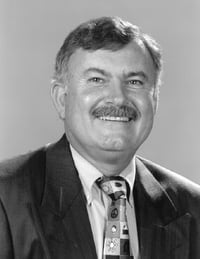
Starting with the firm in 1974, Peter spent 34 years with Ulton, serving as Partner for 31 of them. He saw our clients’ businesses through many seasons of change, and our own business through just as many.
Getting his start as a junior accountant, the firm Peter stepped into on his first day bears little resemblance to the Ulton of 2026.
Back then, our firm operated from 8 Barolin Street Bundaberg—a two-storey building, long and narrow, with dark timber interiors throughout.
Upstairs, a law firm. Downstairs, closest to the front, a building society. And tucked away behind that, was our accounting practice (at the time, operating under the name Schoch, Schoch & Hancock).
Our connection with the building society, Burnett Permanent, was based on a lot more than just proximity. They were also our largest client. So along with sharing our waiting area and reception desk, we also shared in much of the work.
“There were around seven or eight staff in the accounting practice, and probably the same number operating the building society,” says Peter.
Both relatively small operations, Peter recalls the building society having around 5 million in deposits and assets at the time, a figure which he, alongside the staff from both businesses, had the joy of watching grow—though not without a few false starts along the way.
Peter, along with the other staff of 8 Barolin Street got an incredible insight into the zeitgeist surrounding building societies in the ‘70s.
“I saw that original sum pass the 7 million mark three times. The first time, we got it to 9 million. Then, there was a run on building societies when Queensland Permanent Building Society fell into crisis,” says Peter.
Fearful that other building societies would succumb to the same fate, Peter recalls a morning where near-50 customers stood in the foyer, lining up to withdraw their money via cheque. Within a matter of weeks, once anxieties had settled, those very same customers would return with the very same cheques and rebank them.
“So…that happened,” Peter says.
Evidently, the third time was the charm. And when the building society hit its 10 million milestone, that’s when the business really began to hit its stride.
In the late 70s, firm Partner Ron Hancock led a merger between Burnett Permanent and Maryborough Permanent Building Society, forming Wide Bay Capricorn. This extended the accounting firm’s reach beyond Bundaberg and saw Peter regularly travelling up and down the Bruce between the two locations.
By the early 1980s, the building society and accounting firm had grown to around 50 and 15 staff respectively. At this time, the building society was also being run under a secretarial contract by the senior partner of the accounting firm.
Steadily advancing, the pair of businesses found themselves with a luxury few of their peers had access to. They had the resources to embrace the new era of technology.
The Barolin Street operation was one of the first in Bundaberg to get a telex machine, and later, a fax machine. Ever the early adopter, they were also one of the first in town to bring a computer into their building, or, as it was, bring their building to a computer.
“When we first got a computer for the building society, it was so big that we had to extend the building. It was the size of four washing machines, and there were two of them because you had to account for redundancy. Everything ran on discs the size of dinner plates,” says Peter.
Reflecting on the deeply intertwined relationship of the two businesses, Peter acknowledges the significant influence the building society had on the accounting firm’s journey.
“The building society was the tail wagging the dog, in many ways. It had more staff, more resources; a bigger presence, a bigger budget. With that, they gave us exposure to a much bigger world and ultimately influenced the way the accounting practice was run,” says Peter.
“And at the heart of that was the very strong emphasis on customer service. And that is customer service, not client service,” he says.
“Whether you were an existing client or not, from the moment you walked into the building, someone would be there to greet you and make sure you were taken care of,” says Peter.
From early on, customer service values were sowed into our accounting firm’s essence of being. The building society certainly fanned the flames of these principles, but reflecting on the events of his 34 year career with the firm, Peter also credits his two later partners, Daryl Corpe and Mark McLean, for taking this commitment to the next level.

L-R: Partners 2005 | Peter Sawyer, Mark McLean and Daryl Corpe
Daryl joined the firm in 1985 and he and Peter became fast friends. Aligned on their ambitions for the firm, so began a decades-long friendship that continues to this day.
In 1996, the accounting firm and the building society separated. As Ron Hancock moved to focus his attention on nurturing the building society’s growth—which he did very successfully (today, that same building society is known as Auswide Bank)—so began a new chapter of leadership led by Peter and Daryl, with Mark joining the partnership a short time later.
“The three of us had a strong relationship from the very start. We’re very different people, but it just worked. We never worried about the little things that can drive people apart and we always had the future of the firm of mind,” says Peter.
While Peter continued to serve on the board of the building society for many years to come, the separation meant that the society was no longer part of the firm’s day-to-day operation. And thus, the business began to come into its own.
Led by the triad partnership which Peter agrees was greater than the sum of its parts, the firm’s evolution kicked up a notch.
“In the 70s and 80s, we were ultimately operating more like a tax practice. Most clients would come to us once a year to process their tax and that was about it. Back then, everything was also very much price-driven too. Our evolution was really about moving beyond,” says Peter.
Recognising the impact that early, ongoing advice and planning would have in their clients’ lives, our firm set its sights on a more satisfying path forward.
We moved into a higher touch service model—providing management consulting, and shifting into a quarterly and six-monthly planning session cadence with our clients.
“Doing this required more staff because you were processing their work on a more regular basis, but we knew that if we provided the right service with our service, we would ultimately become much more embedded in our clients’ businesses and lives,” says Peter.
And the more embedded we were, the better guidance we could provide, and the better our clients’ financial lives would be for it.
So, conversations that once happened annually began to happen quarterly. Work that had once been transactional became ongoing. Over time, the firm’s modus operandi was shifted from processing outcomes to guiding decisions.
For many of the firm’s staff, this shift came with a change of working environment. Peter recalls many early mornings and long drives out to be with his clients in-person. He’d sit with his farming family clients at the kitchen table before the day’s work began. He’d travel to orchard and grain properties where he’d chat with his clients about work, life, and do a bit of business in between.
Some of those relationships would stretch across decades. Others across generations.
“It exposed me to a lot of different thinking…how those people thought about their business, what they did, the risks they took, and how they recognised and mitigated risk.”
Over time, that exposure compounded. Each industry, each client, each early morning or late evening meeting added another layer of understanding—not just of business, but of people.
It also shaped how Peter saw his role within the firm itself. As the business grew and new generations of accountants came through the doors, Peter found a lot of satisfaction in helping others find their way.
“I suppose I had a knack for simplifying a problem when it came to me. I wouldn’t give them the answer, but I’d give them some thoughts and guidance and let them work the rest out,” Peter reflects.
Peter’s ability to see the big picture and step back, rather than hold on, was a constant throughout his chapters spent with Ulton.
By the time he retired in 2008, the firm no longer required any one person to carry it forward. It’s an achievement our entire team has had a hand in, and a great source of pride for Peter.
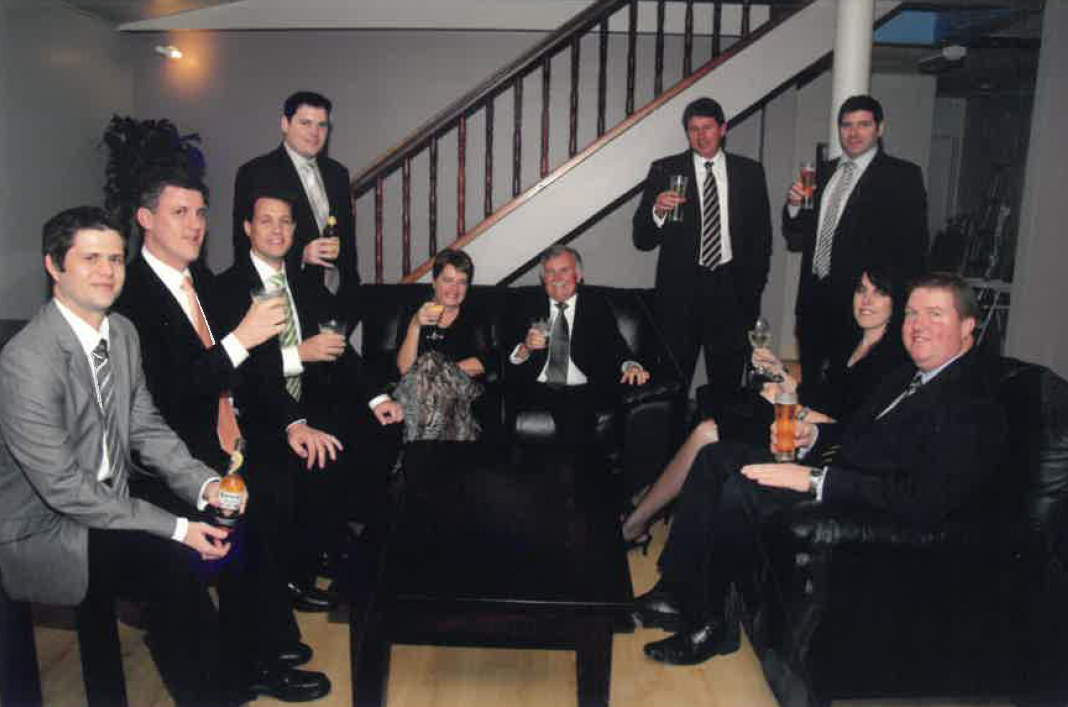
Partnership Group 2008
“It’s always been about the people…First, there was Bill Schoch, and later, Ron Hancock. We stood on the shoulders of giants,” he says
“I feel proud of the shape the firm is in today, the breadth of knowledge that sits within it, and the people who are still there and how well they have progressed,” says Peter.
“It’s a business that knows just how important it is to treasure its clients and train its people.”

%20(1).svg "Frame (18) (1)")

.svg "Close (1)")

 5 min read


 8 min read