

Over the past ten years we have worked with many clients helping them to understand the value of their business. Reflecting on all these clients, at all these different junctures within their lives and business and knowing that they have chosen to place their confidence in us, it’s a humbling experience.
When it comes to valuation, the interaction between the valuer and the client is critical to obtaining the right outcome.
As valuers, independence is fundamental to the work we do. When acting as an expert witness, for example, we’re not there to advocate for any one side, dispense strategic advice, or steer a client towards a particular outcome. We wouldn’t be worth our salt as a valuer if we did.
And yet, it’s precisely because of that independence that business owners and legal professionals place their trust in us. They trust us to be objective, thorough and impartial. They trust us to interrogate the figures and put a defensible value to a business, even when they know there’s a fair chance that our conclusion may not be the one they’d hoped to hear.
A prime example of where that independence is important is in settlement of family law matters.
In family law matters, we’re often appointed as a single expert witness, jointly engaged by both parties via their respective lawyers, to provide an independent valuation. In these matters, our role is to arrive at an objective and defensible conclusion that can assist all parties to achieve resolution.
For family lawyers, it presents a specialised working dynamic to navigate. Though the general approach is not dissimilar to other expert witness relationships, there are specific nuances to be aware of when it comes to the business valuation process.
From the way you instruct the valuer, to the information you share and how you share it, all of this has a material impact on how smooth the valuation process is for everyone involved.
So, as a lawyer, what can you do to set the valuation process up for success?
1. When you first engage your valuer, be clear about what you require
Once you’ve identified that the matter requires a business valuation, the next step is to appoint a valuer. We understand that you’ll want to get the valuation underway as soon as possible. Luckily, there’s a few things you can include in your first correspondence that will help us do just that.
Here’s what to include:
What you need valued
Before you guffaw at the obviousness of such a request, it’s worth pointing out just how often requests come through that misidentify the actual subject of the valuation.
For example, a request might land that asks us to value a business. But that business might be run by a trust or company. And that trust or company might hold other assets that have nothing to do with the business itself.
So, are we valuing the business? The entity that operates it? Or an interest held within that entity?
In a family law matter, that distinction is important. The interest requiring valuation may be the whole business, shares in a company, units in a trust, or another specific ownership interest entirely. Each is a different valuation exercise.
There is, after all, a world of difference between “value the business” and “value my client’s 30% shareholding”.
From the outset, identify both the entity or asset in question and the specific interest you need us to value. The more precise the instruction, the lower the risk of misunderstanding and thus the need to backtrack later.
Why you need it valued
While you might assume your email signature gives us a fairly good clue that we’re dealing with a family law matter, we’ll always seek confirmation over assumption.
It’s important to note that the specific purpose of a valuation does matter. A valuation prepared for family law proceedings is being undertaken in a different context to one being prepared for a tax matter, a deceased estate, litigation, or a commercial transaction. The specific purpose informs the basis of value, the scope of the engagement and the reporting requirements.
So tell us exactly what the valuation is being obtained for and what it needs to establish.
When you need it valued, along with any other key deadlines
There are two streams of timing information we need from the outset.
1. The valuation date: The point in time at which the business or interest needs to be valued.
2. Any other key deadlines: Upcoming mediation, directions hearings, trial dates, or any other milestones that the valuation needs to feed into.
Knowing these dates as early as practical helps us scope the engagement properly and set realistic expectations around timing.
How the valuation will be used (for court or advisory purposes)
Finally, when you first reach out to your valuer, be clear about the intended use of the report. If you’re engaging a valuer as an expert witness, there are formal compliance obligations that must be heeded around the instructions they receive and the report they produce. This differs from the requirements of an advisory opinion that is not intended to be relied upon as expert evidence before the court.
By letting us know at the very start, you’ll save the back-and-forth and get our engagement off to a smooth start.
2. Understand the communication protocols
Impartiality is fundamental to the role of an expert witness. In a joint appointment, that means we need to be especially careful about how each party communicates with us.
If one party has conversations with the valuer that the other isn’t privy to, it can create the impression that the expert has been influenced, calling their independence and the validity of the valuation itself, into question.
What you say and how you say it matters an awful lot in these engagements, so when it comes to communicating with your valuer, be sure to:
Keep communications visible on both sides
Either nominate one solicitor as the central point of contact, or make sure both parties are copied into all correspondence.
Formalise your instructions
Set out the questions and requirements in a written Letter of Instruction and avoid anything that could be seen as steering the valuer towards any particular conclusion.
Specify where information can come from
Agree upfront whether the valuer can source information from third parties (such as the business’s accountant) and/or either party directly, or whether all information must come from the instructing solicitor.
Be mindful of what you share
Once you bring us into the conversation, it’s important to be conscious that what you share with us may lose privilege and become available for review as part of the proceedings. If something is particularly sensitive, strategic, or simply not relevant to the valuation, resist the temptation to share it with us.
Typically, the flow of information will go like this:
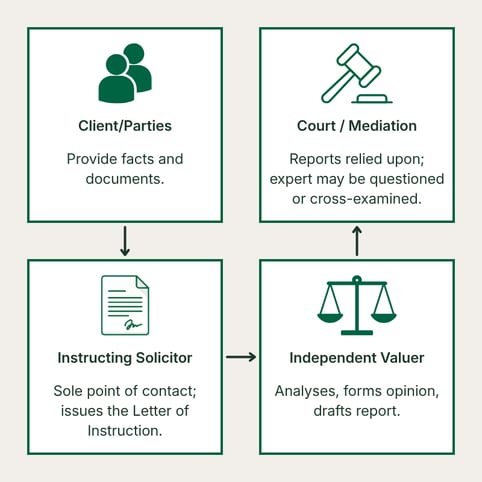
3. Set realistic time frames
For a relatively straightforward matter with well-kept records, a business valuation will typically take around six to 10 weeks, start to finish.
On face value, that might sound generous, but there’s a lot that needs to happen in that time. We need to collect and review documents, work through any question marks that arise, undertake the valuation analysis and, where required, circulate a draft before the report is finalised.
And that’s assuming all records hit our desk in tidy condition. Where there are incomplete or inconsistent records, business interests or dealings that need to be unpacked, or further rounds of questions, time can quickly add up.
Pro tip: Build in a buffer around your mediation and/or court dates. This gives us a bit of breathing room to do the job properly and saves us all from an eleventh-hour scramble when the stakes are already high.
Ultimately, a smooth valuation process takes meeting in the middle
Lawyers speak legal. Accountants speak accounting. While we’re both seeing the matter through our own lenses, a successful engagement hinges on finding the middle ground.
When you’re clear about what you need, when you need it and conscious of the professional boundaries that must be in place, the whole process is made a whole lot easier for everyone, for you, for your valuer and for the parties involved.
If you’re dealing with a law matter that requires a business valuation, don’t hesitate to get in touch with me directly on (07)4197 6300.